June Median House Price Lane County, Oregon: 1/4 Mm

One measure of properties’ appreciation or depreciation is average house price. It’s not exact–it’s really a measure of the average selling prices of houses in any given time. So, for instance, if during hard economic times, people with lower incomes were disproportionately affected, which caused them to sell their houses, where better-off people may choose not to sell, the average price of houses sold would probably be lower.

There’s no doubt that house prices are lower now, in July 2009, than they were in previous years, namely 2008 and 2007. How much lower is a good question. One of my appraiser friends uses 7% in his reports but will tell you privately that it’s more like 10%. This corresponds with my anecdotal evidence of $165/SF to $150/SF from market peak to now, at least in Eugene.

There are 3 measures of central tendency, mean, median and mode. If you look at mean (what most think of as average) and compare it with mode, you can tell (if you remember your statistics) if there are more high-end or low-end houses sold in comparison to the median. Median price in Lane County for June 2009 was: 209.65K, while mean was: 228.5K. This indicates that there were more high-end houses also sold, above the median price. Those numbers come from the most recent RMLS stats.

house-price-june

Eugene Market Time Decreases

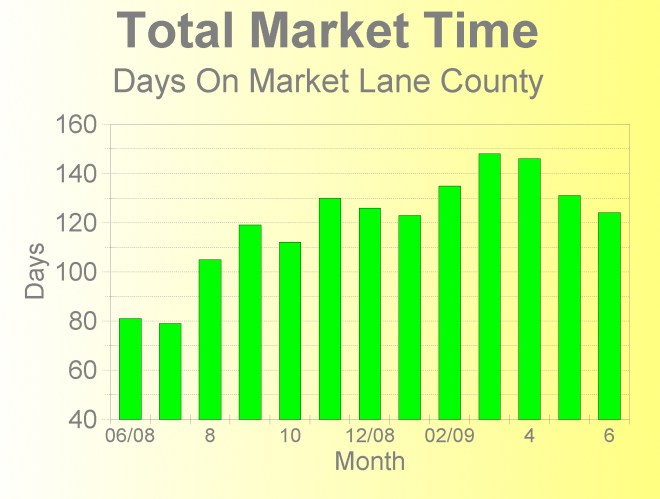
One thing sellers frequently want to know is how long will their house sit on the market before it sells. The most recent stats released by RMLS, the Multiple Listing Service used in Lane County, reveals our current days on market in June 2009 at 124 days, or about 4 months. This is the lowest it’s been since October of last year. Total market time is measured from the time a property is listed until there’s an accepted offer. Decreasing market time is can be an indicator that sales are improving.

market-time-june-2009

How Long the Recession Will Last

So, how long is it? Hard to tell in the dark.

Economics is a rather dark art and will only tell us when the recession is over after it’s over. But only a long time after. My prediction: end of 2009. The reason: the government stimulus should take about 9 months to show up in the economy. And, with some 1 trillion dollars plus being pumped into the economy, that will do something. That’s the equivalent of the government lending each citizen in the U.S. over $3,000.

It is thought that the U.S. consumers account for some 10% of the world’s economic growth, and nearly 3/4 of the U.S. G.D.P. Currently, consumers have zipped their wallets and purses. As soon as the news stops scaring the hell out of us and confidence returns, spending will tick up, and things should improve.

How does this affect housing prices? It should remain a good time to buy through the end of 2009.

Low Consumer Spending Will Change

Low Consumer Spending Will Change

Jumbos: Let Them Eat Cake?

Jumbo loans, those greater than 417K in most areas of the U.S., including Lane County, are becoming delinquent with increasing frequency, according to a recent WSJ article. The rate of jumbos greater than 3 months delinquent has shot up to 6.9%, nearly a 3-fold increase from last year.

Jumbo loans are more expensive than conventional conforming loans, usually by at least 1.5%. The reason: Without the government backing of Fredie Mae or Fannie Mac, investors perceive more risk and demand a higher yield.

So, what does this mean? The market for higher-end houses requiring jumbo loans should be soft. Larger down payments, higher interest rates, and great credit scores reduce the amount that buyers will pay. But, if you have the money, now’s a good time to buy.

Pittock Mansion in Portland.  Used with permission.

Pittock Mansion in Portland. Used with permission.

Fannie Virus

Disgruntled alien attempts to wipe out the U.S. home mortgage system–sounds like a line from Men in Black, to me. But, it’s true. The WSJ reported that a 35 year old Indian-National here on a work visa planted a virus in Fanie Mae’s computers. The virus was set to go off yesterday and destroy all of Fannie’s data, lodged on some 4,000 servers.

The alleged culprit, Rajendrasinh Makwana got fired by Fannie, and apparently thought it was better to get even than get ahead. Mr. Makwana was indicted by a Federal Grand Jury, but has plead innocent. What happened to being grateful to America as the land of opportunity?

The virus was caught in time, and it’s business as usual. Good thing–otherwise it might have been tough to get a loan.

Fannie Mae Headquarters in DC.  Photo by NCinDC.

Fannie Mae Headquarters in DC. Photo by NCinDC.

Getting a Loan with Low Credit

I recently had a chance to talk with Jared Helton of Infinity Lending Solutions, about lower credit scores and how they affect getting a loan for a house.

Q. Are there minimum credit scores to get a loan for a house?
A. For most products, it is stated that there are no minimums on government backed loans. However, most lenders have instituted minimums.

Q. What are the practical minimum credit score limits for the different loan types.
A. FHA: 580 (a few lenders go to 520)
USDA: 600 (a few go to 580)
VA: 580 (a few go to 520)
Conventional: 620

Q. How do lower FICO scores affect loan pricing?
A. For government backed loans, like FHA, USDA, & VA lower credit scores have less affect on pricing with maybe as little as 0.25% for a lower fico between 580 – 619. On conventional loans, it’s a huge change on pricing. Some rates jump over 1% for lower credit scoring around 620.

Q. Is there a minimum score, below which getting a loan is next to impossible?
A. Pretty much below 520 is private money lenders only.

Q. What are some steps to improve your credit scores?
A. Schedule a review of your credit with someone that knows what they are  doing. I’ve written about it on my web-site too.

Q. Does talking to lenders and doing multiple applications hurt your credit score?
A. That is a huge myth that multiple inquires hurt your score.

All multiple “like” inquiries by mortgage companies made in any isolated 45-day period of time for TransUnion and Equifax (14 day period for Experian) are treated as one single inquiry for the calculation of the score.

Any mortgage inquiry made during the 30 days prior to the current broker/lender’s mortgage inquiry will be buffered out of any impact in the consumer’s score calculation.

Jared Helton, Partner, Infinity Lending Solutions

Jared Helton, Partner, Infinity Lending Solutions

Oregon’s Population Rising

Population change in a state is one factor that influences housing prices. After all, house prices are a fundamental supply and demand situation. Inward migration tends to create more demand and push up prices.

Oregon is projected to increase in population for the fiscal year 2008 by 1.8% to about 3.8 Mm people. Contrast this to California, which will lose 144,000 people. As most Oregonians know, we’re one likely stop for our southern neighbors. Strong growth is projected for the Portland area. Lane County will grow by about 2,700 people to 346,000.

A good place to be from?

California: A good place to be from?

Hi Credit for Best Interest Rates

Credit scores are increasingly important to getting loans, and loans of course are usually necessary to purchase a house. Banks have grown more and more averse to bad loans, so they’re wanting better credit scores. And the higher your score, the lower your interest rates.

FICO scores of 760, up from 720, are now necessary to get the cheapest rates on conventional 30 year fixed mortgages, according to a 3 January 09 WSJ article. The article also said that the new FICO scoring model will be even more sensitive to on time payments. So, pay your bill on time, if you can.

Sky-High Credit is Required for Best Interest Rates.  Photo from Springfield Oregon.

Sky-High Credit is Required for Best Interest Rates. Photo from Springfield Oregon.

Commercial Loans in Lane County

I recently had the chance to speak with Pat Costello at Selco Credit Union about commercial lending in Oregon. Pat, having worked at some of the biggest banks around before coming to Eugene, is not your usual small town banker. An MBA from the University of Chicago, rental ownership, and a Board spot at the Eugene ROA give him keen insight into commercial property in Lane County.

The credit crisis has many lenders in a stingy mood; they’re holding on to their capital (not readily making loans) to cover bad or questionable loans already on their books. This isn’t the case with Selco–they’re still making loans.

Two of the ratios that are critical to your loan are DCR and LTV. DCR, debt coverage ratio, is probably the most important, and the bankers like to see a minimum of 1.20 to 1.25 these days. DCR is a measure of income to debt servicing. In simple terms, the project will need to clear a dollar and twenty five cents for every dollar you’ll apply to paying down the loan.

DCR tends to be more restrictive than loan to value. In order to meet the 1.20 minimum DCR, your LTV, loan to value, ratio will most likely not exceed 70%, at least for properties around here.

Construction money is still available at Selco for good projects. Loans up to 75% LTV for interim construction funds are possible, with up 80% LTV possible for permanent financing. In today’s economic climate, I think it’s fair to say, that Selco has grown more selective on loans.

Interest rates follow the Seattle Home Loan Bank’s 5 year commercial bullet index. Loan structure is frequently fixed for 5 years before adjusting, with a 10 year call, and 25 year amortization. The banks look at the 3 C’s when scrutinizing a potential loan:

C Collateral
C Cash Flow
C Credit.

While the ratios and standards have grown more restrictive, there are local programs available to assist borrowers get more money through the Small Business Association. Pat is familiar with those too. If you’d like to reach Pat, give him a call at 744-7519.

Pat Costello at Selco

Pat Costello at Selco

Buyer’s Market in Eugene

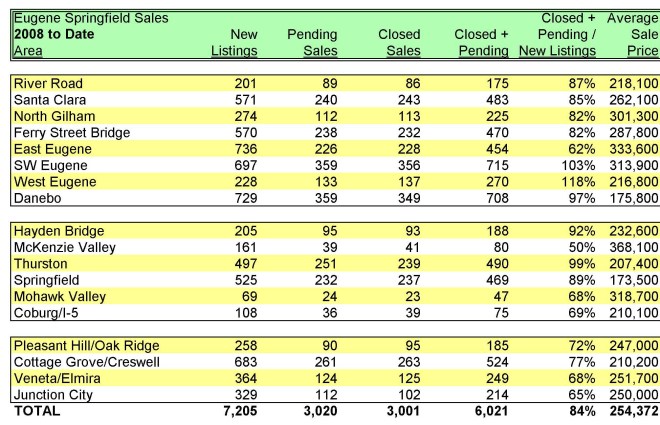
Every month, I compile our local real estate market statistics. I start with the data supplied by our local multiple listing service, used by most area realtors, RMLS. Last month’s summarize 2008, and are in the table below.

Supply of houses, based on the rate of sales, didn’t dip below 8 months for the entire year. Levels above 6 months are said to be a buyer’s market. So, last year was good for buyers and not so good for sellers.

Time on the market, the time from when you list your house until you sell it, was about 4 months. About 6,000 homes were sold or went pending, in the greater Eugene area, in 2008. Nearly 3/4 of a billion dollars of houses sold in Lane County last year. So, houses are selling.

Prices have fallen. How much is not as easy to figure out as you’d think. For instance, median sales price for the year 2008 was 220K, down 6.3% from 2007 (234.9K). When you compare median sales price of December 2008 vs. December 2007, 2008 is down 11% (200K vs. 225.6K). And, when you compare 2008 vs. market peak, in June 2007, the drop is 9.7 % (220K vs. 243.5K). So, what is it? My rule of thumb is prices are down about 10% from 2007. Put another way, houses have fallen from about $165/s.f. to $150/s.f., in broad terms.

In summary, now is a good time to buy and things are still selling.

December 2008

Eugene Market Information: December 2008

Year to Date.  Click the image to see the whole table.

Year to Date. Click the image to see the whole table.