Filed under: People and Business, Uncategorized | Tags: building codes, construction, Craig Tomlinson, earthquake, Lane County, springfield oregon
Filed under: People and Business, Real Estate, Uncategorized | Tags: Craig Tomlinson, employment, eugene oregon, housing crisis, Lane County, logging, lumber, Springfield Real Estate, wood products
The logging and wood products industries are recovering, but slowly. Both are significant sources of employment in Lane County. Additionally, the housing market is the chief source of demand for wood products. Construction of more single-family houses is what’s needed, but building of such homes is at low levels around Eugene Springfield—and nationwide.
Before more new home building can start up, the inventory of existing homes for sale needs to decrease. In the meantime, it’s a great time to buy.
Filed under: Real Estate, Uncategorized | Tags: 2011 Home Construction Eugene Springfield Oregon, Craig Tomlinson, eugene oregon, Eugene Real Estate, Eugene Real Estate Blog, Lane County Real Estate, Oregon Real Estate, Oregon Real Estate Blog, Real Estate Blog, Real Estate Information, Real Estate News, Real Estate Resource, Springfield Real Estate
New home construction fell to an all time low in February 2011, with an annualized national number of building permits at 517K. In Eugene Springfield new residential building is very slow right now. New building permits issued in January were reported to be 27, down 13% from January 2010. 466 building permits were issued in Eugene Springfield for all of last year.
Distressed properties are often cheaper than replacement cost, and there’s a lot of inventory of all types of houses to be sold; until both of those change, I don’t expect new house building to pick up much.
It’s still a great time to buy, though. Prices are down in Eugene Springfield and there are some great values.
Filed under: Real Estate, Uncategorized | Tags: Eugene Oregon commute times, Eugene Springfield quality of life
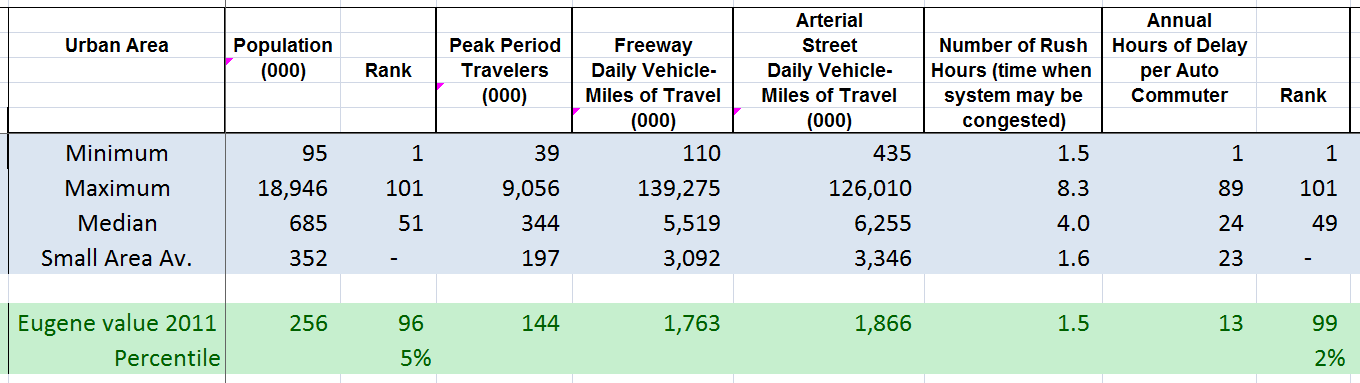
Often, people choose to live in Eugene or Springfield because of their excellent quality of life, including low crime rates, close proximity to recreation, and short commute times. I sometimes forget how much of a convenience a short commute can be. I live in the country and am at my office on River Road in about 12 minutes, and less if I’m running late.
A recent article pointed out that over 3 million Americans have commutes over 90 minutes each way to work. That 3 hours a day adds up to over 20 weeks a year spent in your car per year. Yuck. Commute times in Eugene are short. Nearly ½ of us spend less than 14 minutes each way getting to work, and about 3/4 of us spend no more than 19 minutes.
As a brilliant marketing campaign says, “we’ve got it good.”
Filed under: Real Estate, Uncategorized | Tags: Craig Tomlinson, eugene oregon, Eugene Railroad, Eugene Real Estate, Eugene Real Estate Blog, Lane County Real Estate, Oregon Real Estate, Oregon Real Estate Blog, Real Estate Blog, Real Estate Information, Real Estate News, Real Estate Resource, Springfield Real Estate
We don’t often think about the Railroad in Eugene, unless there’s a problem–it’s just one of those things we take for granted. We are on the main-line between Seattle and Los Angeles, and local manufacturers still ship and receive product by rail car, a very efficient transportation method. (A train can move a ton of freight over 400 miles on 1 gallon of fuel, some three times more efficient than trucks). And, shooting up to Portland or Seattle via Amtrack is popular.
Gone, at least for now, are the major switching operations in the Eugene railyard. After Union Pacific bought Southern Pacific, many of the Eugene yard’s functions were consolidated to Roseville and elsewhere. When I was growing up here, S.P.’s yard was a significant employer. In the necessary drive towards efficiency, those jobs seem to be gone. Interestingly, rail shipping rates in the U.S. are the cheapest in the world.
On a brighter note, the elimination of the Eugene switching yard has made the adjoining neighborhoods in Santa Clara, River Road and Bethel more desirable. Train noise was a perceived problems when switching was occurring, but that’s been largely made a non-issue.
Filed under: Real Estate, Uncategorized | Tags: Craig Tomlinson, eugene oregon, Eugene Real Estate, Eugene Real Estate Blog, green power, Lane County Real Estate, Oregon Real Estate, Oregon Real Estate Blog, Real Estate Blog, Real Estate Information, Real Estate News, Real Estate Resource, renewable energy, Springfield Real Estate
Eugene thinks of itself as a Green city, but it sounds like Reno may be beating us on this front. They recently installed nine different wind turbines so that the City and the public could evaluate their performance. Reno also has solar power helping to generate electricity. One thing that’s cool about their system is that you can go on-line and look at its power generation real-time. Looks like Eugene has some catching up to do.
Filed under: People and Business, Uncategorized | Tags: Craig Tomlinson, eugene oregon, house prices, House Prices Eugene Oregon, Lane County, springfield oregon
In a recent Wall Street Journal article it was reported that the rate of economic expansion (GDP increase) is expected to be its largest since 2003. And while national unemployment is still high, it is expected to dip below 9% by the year’s end. Currently the unemployment in Lane County is still above 10%.
So what does this mean for housing prices? Housing prices are affected by a number of factors, but fundamentally, it comes down to supply and demand. High unemployment decreases demand; you need a job in order to pay your mortgage. I expect a soft market in Eugene Springfield until our stubbornly high unemployment rate drops.
Filed under: Eugene Realty Listings, People and Business, Real Estate, Uncategorized | Tags: commercial real estate eugene oregon, Craig Tomlinson, eugene oregon, Eugene Real Estate, House Prices Eugene Oregon, Lane County Real Estate, Oregon Real Estate, sustainablility
Increased density and more multi-family housing in Eugene is what the powers that be see in our future. We’re still a few weeks off from learning if the Urban Growth Boundry (UGB) will grow. My guess is not, but we shall see. The unintended consequence of a tight UGB is higher land cost, and therefore less afordability, but this is often overlooked.
Filed under: Real Estate, Uncategorized | Tags: commercial real estate eugene oregon, Craig Tomlinson, Eugene Real Estate, Real Estate News
High quality commercial real estate is in demand, and prices are edging up. Both in Eugene and nation-wide. Why? The lack of alternative investments. Even 6% or 7% cash-flow coupled with appreciation is good compared to minuscule interest paid by banks or bonds.
For instance, a year ago the Mortgage Bankers Association sold it’s glass-walled office building to real-estate data firm CoStar Group Inc. for $41.3 million (they purchased the building in 2007 for $79 million–ouch). Now, a German real-estate fund is buying the building from CoStar for $101 million. Seventy million in a year–that’ll get your attention.
Woodfield Station in South Eugene (Willamette Plaza on 29th and Willamette to old-timers) recently sold for over 25 million dollars to Iowa PERS. The previous owner, an insurance company, purchased the property in 1971 and subsequently redeveloped it over the years. Cap rates weren’t disclosed, but I’d guess they were low.
High quality is back in fashion again. Contact me for your commercial real estate needs in Eugene.
Filed under: Real Estate, Uncategorized | Tags: first-time home buyers, new housing, smaller housing
New homes are starting to get smaller for the first time in nearly three decades. The average size of new single-family homes dropped from 2,521 square feet in 2007, hit a plateau in 2008 and began falling in 2009. The average home now has fewer beds and bathrooms as well. This decline of home size has not been solely caused by the crash in the housing market, and instead has decreased due to other factors, such as an increased share of first-time home buyers and a desire to lower energy costs.